



“In [research], if you know what you are doing, you should not be doing it. In engineering, if you do not know what you are doing, you should not be doing it.” - Richard Hamming
Going from -1 to 0 isn’t an engineering problem. The notion of being pre-0, by definition, presupposes a sense of unspooling, of unbecoming. It’s vulnerable. It’s new. It demands curiosity. Both research and the entrepreneurial act share this sense of fundamental openness.
You take the leap into the “-1” to aim higher and crazier in the pursuit of your life’s work. You do it to build and understand AGI, to usher in new substrates and models for computing, to pave the foundation for a new industrial revolution, and to reach for the stars.
As in fundamental research, building something great comes from asking the right questions, surrounding yourself with incredibly talented people, and learning with urgency. It doesn’t come from isolation.
To ask a good question implies that there is something you do not already know. It may take a career to formulate a question worth asking, but that quest—to find questions worth living—is the critical path.
Questions, not answers
Curiosity infects and organizes. You notice it immediately at SPC—the curious embody a kind of tension that feels almost like an infection, up close: no matter what they’ve achieved in the past, there’s a gnawing intensity that pulls them into new orbits.
These are the kinds of members we’re drawn to at SPC. Tuhin Srivastava, who joined the community back in 2019 alongside friends digging into deep learning and then started Baseten while at SPC. James Cadwallader and Dylan Babbs, who independently joined to explore ideas ranging from flight simulators to tuna fishing and teamed up to start Profound. Scott Wu, who joined as a 20 year-old competitive programmer and is now building Cognition. Bill Chang, who built Tesla’s Dojo supercomputer and is now rethinking memory architecture from the ground-up for inference at Density AI. Tom McGrath, who led LLM interpretability at DeepMind and is now building Goodfire to understand the models we rely on everyday.
Imagine each of these people’s adjacent possibilities as a magnetic field:

Though the field is pervasive, it’s not actually legible unless there’s a ton of iron around the magnet. Being around other curious, technical people helps you map out the field. This “mapping” involves spending time in both structured and unstructured exploration (mostly the latter). We organize many of these “structured” motions at SPC: forums, squads, roundtables, etc. These change frequently, by design, as our areas of talent density evolve. SPC is always a malleable and fluid collection of explorers who move between areas of focus as the frontier of technology shifts.
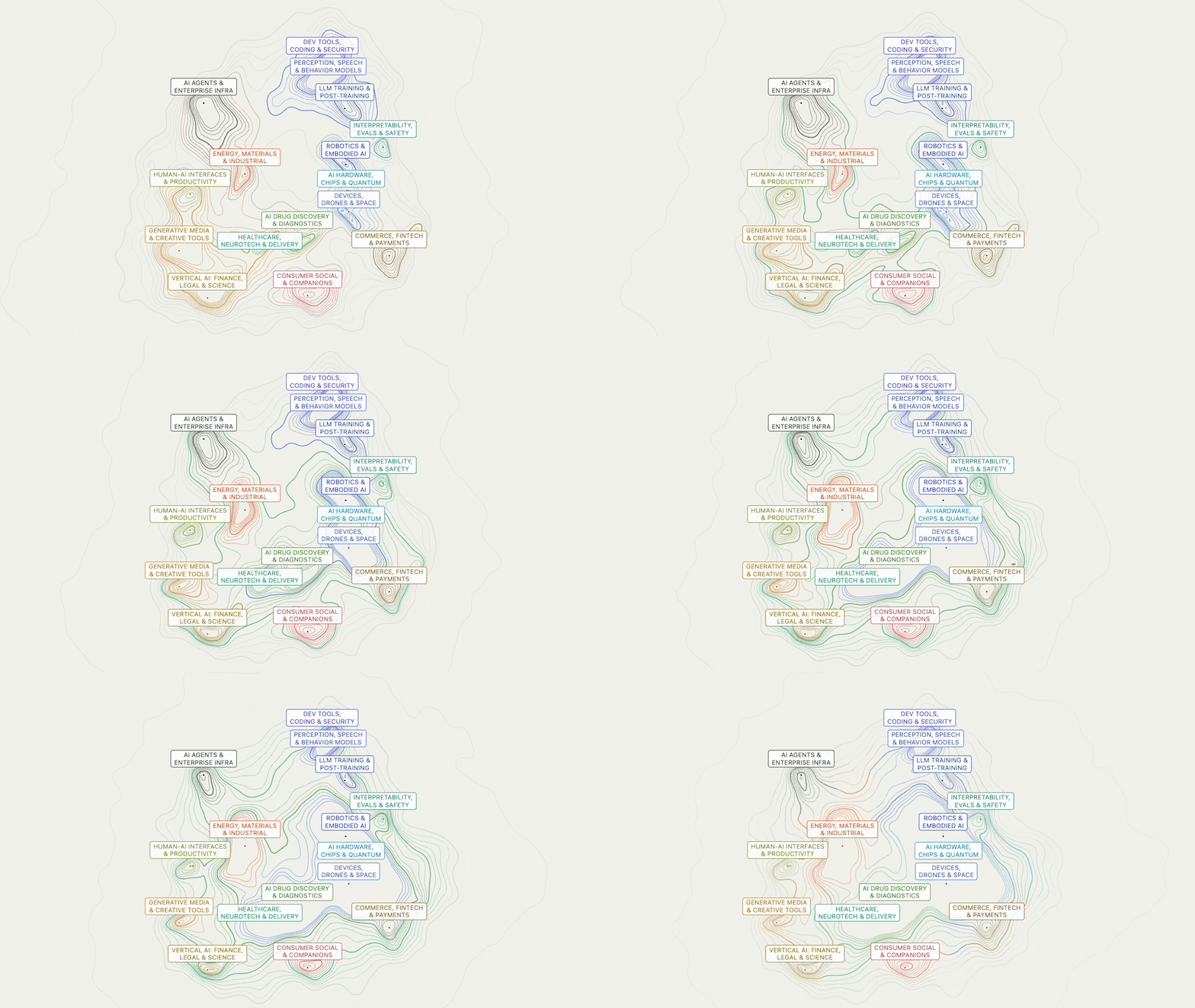
Combined with the “unstructured” time (lunchtime conversations, introductions to customers and potential team members, intermittent shoulder taps), these are how members help each other make sense of the nature and direction of their own fields of curiosity.
When Tom Brown—who, five years later, would co-found Anthropic—joined SPC, he was a beginner tapping people on the shoulder. He was a former founder and engineer. Not an AI researcher, but he wanted to learn. “I joined SPC, blocked off three months to see if I could make progress, and made a plan to teach myself machine learning. Starting down a new path is hard. For me, SPC provided an environment where I felt comfortable putting aside my armor of expertise. It gave me a community where I could be a novice again.”
We’ve drawn inspiration from environments that encourage and incubate out-of-distribution ideas. Think: Bloomsbury Group, not “English 101.” Applied Physics Laboratory’s cafeteria, not “Intro to Physics.”
Take the invention of GPS, for example.
In 1957, two physicists at APL argued about the microwave signals emanating from Sputnik (which recently launched the weekend before). Individually, they were curious. But through their environment—namely, other curious and driven researchers—they found the energy and support to build conviction. They scrambled around and locked onto the signal later that day and realized that the Doppler effect was at work because of the satellite’s motion and distance. Over the next few weeks, they found out how to determine where Sputnik was in orbit based on its radio waveform. Frank McClure, director of APL, then asked them to reverse the problem—i.e., pinpoint an unknown terrestrial location based on a known orbital one, which gave birth to GPS. Sixty years later, satellites blanket the earth with navigation.
Guier and Wiffenbach, the two physicists in question, discovered GPS. But APL—with its talent density, intensity, and culture of curiosity—made it possible.
Community, not isolation
What ties together founders who build massive companies from their dorm rooms and hackers from Xerox Parc and artists in 15th century Florence? What makes their environments different? You can put fifty smart people in one building and still get nothing. What makes these pockets of brilliance tick?
For starters, interruption and interrogation are features, not bugs. That tap on the shoulder, the general air of specific curiosity, the earnest question that only someone with broad context (and care) can ask—these are the ingredients for creative and fertile environments. Of the original iPhone team’s culture, Ken Kocienda writes, “our iterative working method was like the air—something all around us all the time, something we were always aware of on some level, something it didn’t make sense to question … programmers and designers on the [iPhone] project were in and out of each other’s offices all the time. We exchanged frequent feedback on our work, and all of us were expected to field questions.”
There also must be a natural, innate draw to the frontier. Since our inception, we have actively sought out members who are not just curious about the future but who actually live in it: roboticists like JX who’ve been building robots since they were children, hackers like Yaroslav who’ve lived and breathed AI far before today’s wave began, technologists like Nato with polymathic legacies across BCIs, rockets, and satellites.
In the right magnetic fields, you can feel a thrumming in the background because peers are primed for the productive entropy that surrounds them. Each day, each week may bring something completely new: the electronics club; a co-worker hacking on a side project in the cafeteria; a potential cofounder knocking on your dorm room door. They compress, publicize, and celebrate experimentation and learning.
Having a tribe of fellow adventurers, each on their own quests, makes the journey more joyful, interesting, and likely to lead you somewhere worth going.
To end at the beginning, with Hamming:
Those who claimed there was no essential difference [between computers and hand computations] never made any significant contributions to the development of computers ... when something is claimed to be new, do not be too hasty to think it is just the past slightly improved—it may be a great opportunity for you to do significant things. But then again, it may be nothing new. - Richard Hamming
An earlier version of this piece was published in January 2025.
The Case Against Talent Density
Why being surrounded by smart people is not the same thing as thinking.
https://substack.com/@archepersona
Sep 16, 2026
There is an increasingly popular idea in technology that the earliest stage of invention—the mysterious “-1 to 0”—is best navigated in groups.
Surround yourself with exceptional people.
Have conversations.
Get interrupted.
Ask questions.
Let ideas collide.
Eventually, through some intellectual Brownian motion, something worth building emerges.
There is value in this.
There is also a problem.
If your primary mechanism for discovering what you don’t know is waiting for another intelligent person to ask you a good question, you have outsourced one of the most important functions of thought.
Critical thinking.
Questions Are Not a Community Feature
A good question exposes an assumption.
Why does this work this way?
What happens if that assumption is wrong?
What evidence would prove me wrong?
Why hasn’t somebody done this already?
Am I solving the actual problem, or merely the version of the problem everyone has agreed to discuss?
None of these questions require a room full of founders.
They require intellectual discipline.
The ability to interrogate your own thinking should not be confused with access to people willing to interrogate it for you.
Those are very different capabilities.
Community can supplement critical thinking.
It cannot replace it.
And if it does replace it, something has gone badly wrong.
Talent Density Has Another Name
Consensus.
Put enough intelligent people in the same environment and something interesting happens.
They exchange ideas.
They challenge one another.
They teach one another.
They also begin sharing assumptions.
They read the same papers.
They know the same investors.
They attend the same conferences.
They use the same vocabulary.
They notice the same trends.
They become excited about the same technologies.
Eventually, an environment created to expand the possibility space can quietly begin narrowing it.
This isn’t because the people aren’t intelligent.
It happens precisely because they are intelligent.
Smart people are exceptionally good at constructing sophisticated explanations for assumptions everyone around them already accepts.
Fifty intelligent people can challenge one another endlessly without anybody asking the question that exists outside the intellectual boundary of the room.
Talent density increases collisions.
It does not guarantee diversity of thought.
Isolation Has an Undeserved Reputation
There is a romantic story about invention happening in communities.
There is another romantic story about the lone genius.
Both are incomplete.
The useful question isn’t whether someone works alone or in a group.
It is whether their environment allows an idea to survive long enough to become strange.
New ideas are fragile.
Before there is evidence, there is often only an observation.
Something doesn’t fit.
Something behaves differently than expected.
Something everyone accepts suddenly looks ridiculous.
At that stage, consensus isn’t always helpful.
Sometimes you need uninterrupted time to follow the stupid question.
You need enough independence to continue when nobody else understands why you’re interested.
You need the willingness to spend three days investigating something everyone around you considers irrelevant.
You need to be comfortable being wrong without an audience.
That is not loneliness.
That is cognitive independence.
And it matters.
The Frontier Doesn’t Have a Networking Event
If everyone agrees where the frontier is, it probably isn’t the frontier anymore.
By definition, genuinely unexplored territory is difficult to recognize.
There are no signs.
There is no established vocabulary.
There may not even be a recognized problem.
This is why some discoveries begin with observations that initially sound trivial:
Why did that happen?
Why can’t the system know that?
Why does everybody build it this way?
Why are we accepting this limitation?
What if the limitation isn’t real?
The important capability isn’t having someone nearby who can ask those questions.
It is developing a mind that cannot comfortably leave them unanswered.
The Scarcer Resource Is Not Talent
There are more technically capable people alive today than at any previous point in history.
They can communicate instantly.
Research is searchable.
Code is accessible.
Models can explain unfamiliar fields in seconds.
Experts who once would have been unreachable can be found online.
The historical cost of intellectual adjacency has collapsed.
What remains scarce is something else.
People willing to question the frame itself.
People willing to admit they don’t understand something.
People capable of separating evidence from consensus.
People who can hold an unresolved question without prematurely converting it into an answer.
People willing to discover that six months of their own thinking was wrong.
That isn’t talent density.
That’s epistemic discipline.
And you cannot manufacture it by putting fifty impressive résumés in a building.
Community Is an Amplifier
None of this makes community worthless.
Quite the opposite.
Put someone with genuine intellectual independence into a strong community and extraordinary things can happen.
Someone sees a blind spot.
Another person knows an obscure piece of research.
Someone asks the question you somehow missed.
Someone connects two ideas you had never placed beside each other.
That is valuable.
But notice what community is doing.
It is amplifying an existing process.
It isn’t creating it.
Without independent critical thought, talent density risks becoming intellectual dependency: people looking sideways to determine what is interesting, what is credible, what should be built, and what questions are worth asking.
With independent critical thought, community becomes enormously powerful.
The ordering matters.
Learn to Ask the Damn Question
The goal shouldn’t be to find an environment that asks better questions for you.
The goal should be to become exceptionally difficult to satisfy with bad answers.
Interrogate your assumptions.
Look for contradictions.
Follow anomalies.
Ask what evidence would change your mind.
Learn enough outside your field to recognize when your field has mistaken convention for necessity.
Then go find brilliant people.
Argue with them.
Learn from them.
Let them destroy your favorite ideas.
Destroy a few of theirs.
Build things together.
But don’t confuse the room with the thinking.
The room is useful.
The thinking is the thing.