


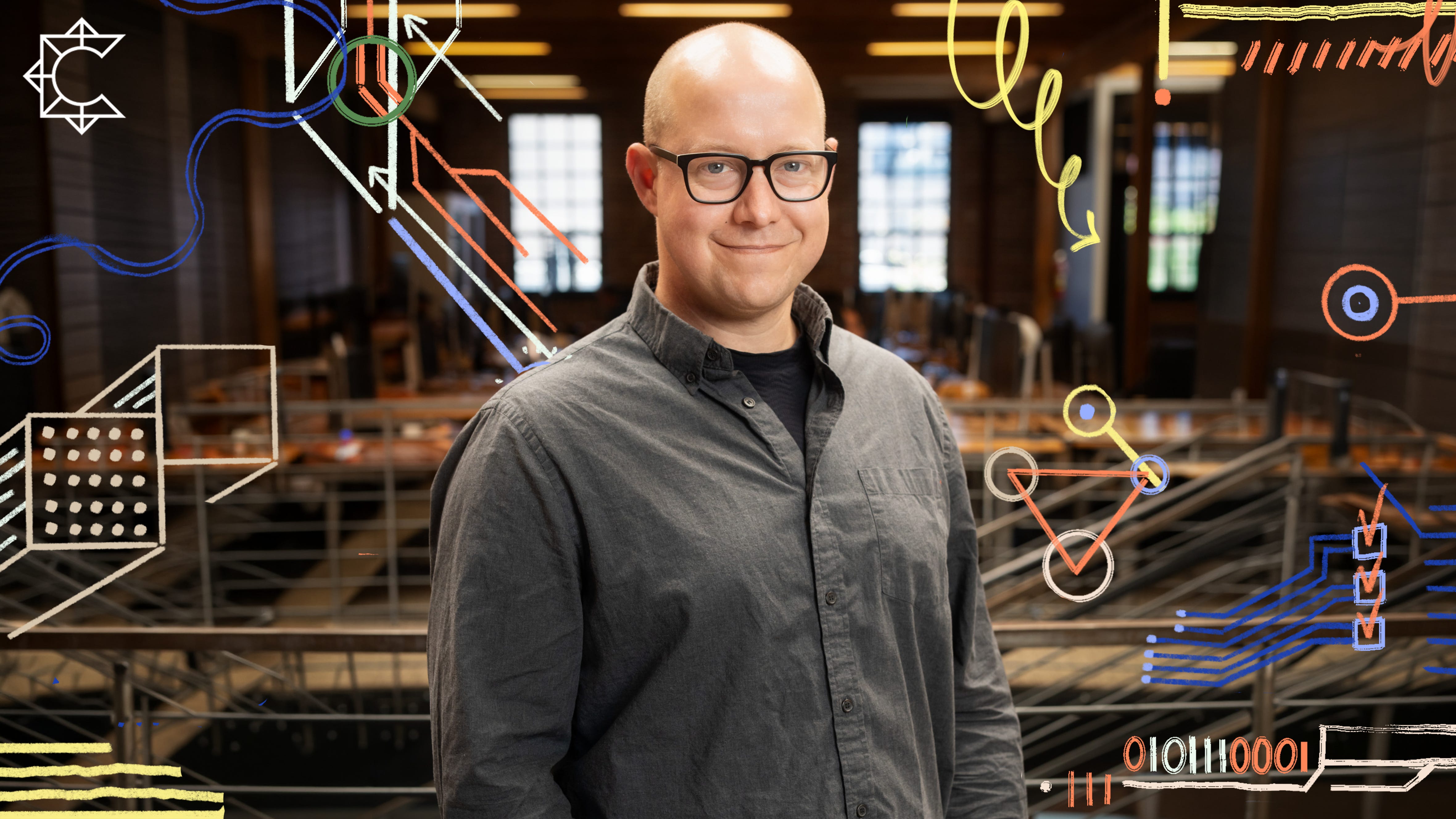
We’re excited to announce Ryan Atkins has joined the SPC team as Partner, Operations. Ryan’s background spans across dimensions (literally, he spent the first decade of his career teaching physics).
Ryan also spent 10+ years scaling engineering & product teams at Asana, Stripe, and Dropbox. He was the founding site lead for Asana’s Warsaw office, growing it to over 150 employees.
We spoke to Ryan about his love for operating systems and culture building and where he’s most excited to contribute at SPC.
What does the Operating Partner role look like at SPC?
Ryan: My primary role is focused on improving the systems and programs that allow the SPC community to thrive. My goal is to help the partners help members, and help members help each other. This means everything from how we source and market candidates, new member onboarding, to helping members make sense of their own journeys. Day to day, this means anything from moving the furniture to re-writing SPC’s values. Nothing is too small or too big.
What does your past experience look like?
Ryan: I grew up in the Bay Area, studied physics at Stanford, and then did a master’s in education. I figured I’d teach for a year or two, and I ended up doing it for ten, at Eastside College Prep. Teaching taught me things I still use every day—how to build organizational systems, and how to get the best out of a group of people. What I loved was the depth. You go deep with students, you get to know what makes them tick and how to help them grow. You’re limited by breadth though, because a classroom is small. That contrast is what eventually pulled me toward software, because of its ability to reach so many more people.
The transition happened through Aditya [SPC Partner], who I’ve known for about 20 years through college friends who’d ended up at Facebook. I told him I was burnt out from teaching, and he invited me to interview at Dropbox where he’d taken the CTO job a year earlier. I joined and helped build and scale the cultural systems there, straddling both the people and engineering organizations, somewhere between an operational generalist and a technical program manager.
From there I went to Stripe, which was around 1,000 people when I joined and growing fast. I spent about a year and a half in a similar role, sitting between engineering strategy and the people-team cultural investments, on what was broadly called the Education Team.
Then in 2020 I moved to Asana. I was looking for a smaller organization and more engineering-directed work. I came in to lead engineering operations and served as Chief of Staff to the CTO, and ended up staying for nearly six years. I helped scale the org, moved into an Engineering Director role overseeing the adoption and growth of the product, and eventually relocated to Poland as the founding site lead to launch our Warsaw office which we grew to about 150 people.
What drew you to SPC?
Ryan: I’ve been following the SPC team for a long time, and I actually visited back in 2017. So a lot of this was familiar to me. There’s this gravitational force behind the talent density here, it’s hard not to pay attention to that. What I love—whether it’s software or the design of our own team—is operating systems. SPC is a genuinely unique version of that: a small team paired with a large community. It’s the best of both worlds. SPC is a small team that builds at lightning speed, but also has real problems of scale. On top of that, we’re at a crazy moment in technology. The boom in AI is creating seismic waves in entrepreneurial opportunity. It’s very exciting.
What’s something most people get wrong about operations and scaling?
Ryan: People too often pit operations against strategy, like you’re either an executor who does the work, or you’re the one strategizing about it. But operations has a strategy of its own. There’s a strategy to how you operate. The choices and decisions you make reflect your values and goals. You can be highly strategic in an operational role. The other thing is that culture is an incredibly important variable. You can scale in fairly predictable patterns, but so much of what underpins an operating model comes down to culture. Stripe, Asana, and Dropbox all felt very different. What I respect and value is the way a founder’s DNA percolates through a company with their personality—how they act, behave, and what they believe.
What’s a lesson that shows up over and over, regardless of company?
Ryan: Every organization tends toward disorder as it evolves. Entropy is real. For example, there’s an explosion of noise that every organization eventually has to reckon with. Part of the job of an excellent operator is to increase the signal. Sometimes that means amplifying the signal, sometimes it means decreasing the noise. The best operators do both. And repetition doesn’t spoil the prayer. You just have to say things over and over, finding novel ways to do it. That’s true for a teacher in a classroom and it’s true for a CEO in a company.
You spent the first decade of your career teaching physics. What from the classroom still shows up in how you work with builders today?
Ryan: Ten years of trying to get 13-year-olds to listen to you was survival of the fittest. The evolutionary pressure of a classroom forces you to learn every trick for keeping people engaged. You learn to listen and to meet people where they are. The culture becomes the infrastructural layer you build everything else on top of. You need the foundation. The goal is to build structures that make it easiest for our founders to follow the best path, make it hard to screw up and easy to succeed through tools, communication patterns, programming.
Across all of my roles, I’ve always worked on onboarding. For a teacher, the most important day, by far, is day one. What standards do you set? What rituals do you establish? On my first day, I’d hand each student a textbook along with a seating chart, and I’d take the time to pre-write every student’s name—adding them to the legacy of those who held the book in prior years, helping them feel like a part of history.
A year from now, what would make you feel like your work with the SPC community really mattered?
Ryan: I think about my impact the way we think about life-changing technology and how it makes you ask the question, how did we ever operate and build without this? You can’t quite remember or imagine the time before. Success looks like everyone operating at a higher level of execution than before, and feeling good about the work they’re doing.
It’s a lofty goal and hard to pin down, but ultimately the purpose of this organization is for the companies and people we invest in to be thriving. I hope everyone feels great about SPC. Everyone who works here should feel like this is the best work of their life, and everyone we invest in should feel that SPC inflected their trajectory, accelerated their ability to have impact, changed the lens through which they see the world.
Interested in SPC? Apply to join us here.