



The opportunity has never been greater. Neither has the risk of building the wrong thing. I spoke to the SPC community about the state of the market for founders building in and around AI. Weeks of debate followed, and the conversation continues to evolve.
It increasingly feels like founders are building under the Eye of Sauron. In Lord of the Rings, the Eye of Sauron is an all-seeing force. Once it fixes on you, there’s nowhere to hide. Today, the foundation model labs are starting to feel the same way and the line of sight is only getting bigger.
Competition is no longer one-dimensional. There are now four vectors: incumbents, other startups, the foundation models themselves, and—most importantly—your own customers.
The labs aren’t just building better models. They’re arming your customers.
To understand what that means for you, evaluate your startup across three dimensions.
Buyer Capability: Can your customers actually wield the new AI tools?
Buyer Agency: Are they empowered to just go build?
Product Architecture: Is your product primarily workflow or chassis?
While capability and agency are about your buyer’s skill and autonomy, product architecture asks where your product sits in the stack.
Workflow lives at the interface layer — the surface users directly interact with to get a job done.
Chassis is the underlying layer — data, security, orchestration, identity and access, compute, deployment. The enabling infrastructure that everything depends on.
The more your product lives at the workflow level, without deeper roots in chassis, the more exposed you are.
If your buyers are high-agency, high-capability, and your product is mostly workflow, you’re at real risk of them building their own version of your product. I’ve seen it firsthand — internal teams spinning up bespoke tools in days that would have taken months to procure and implement a year ago.
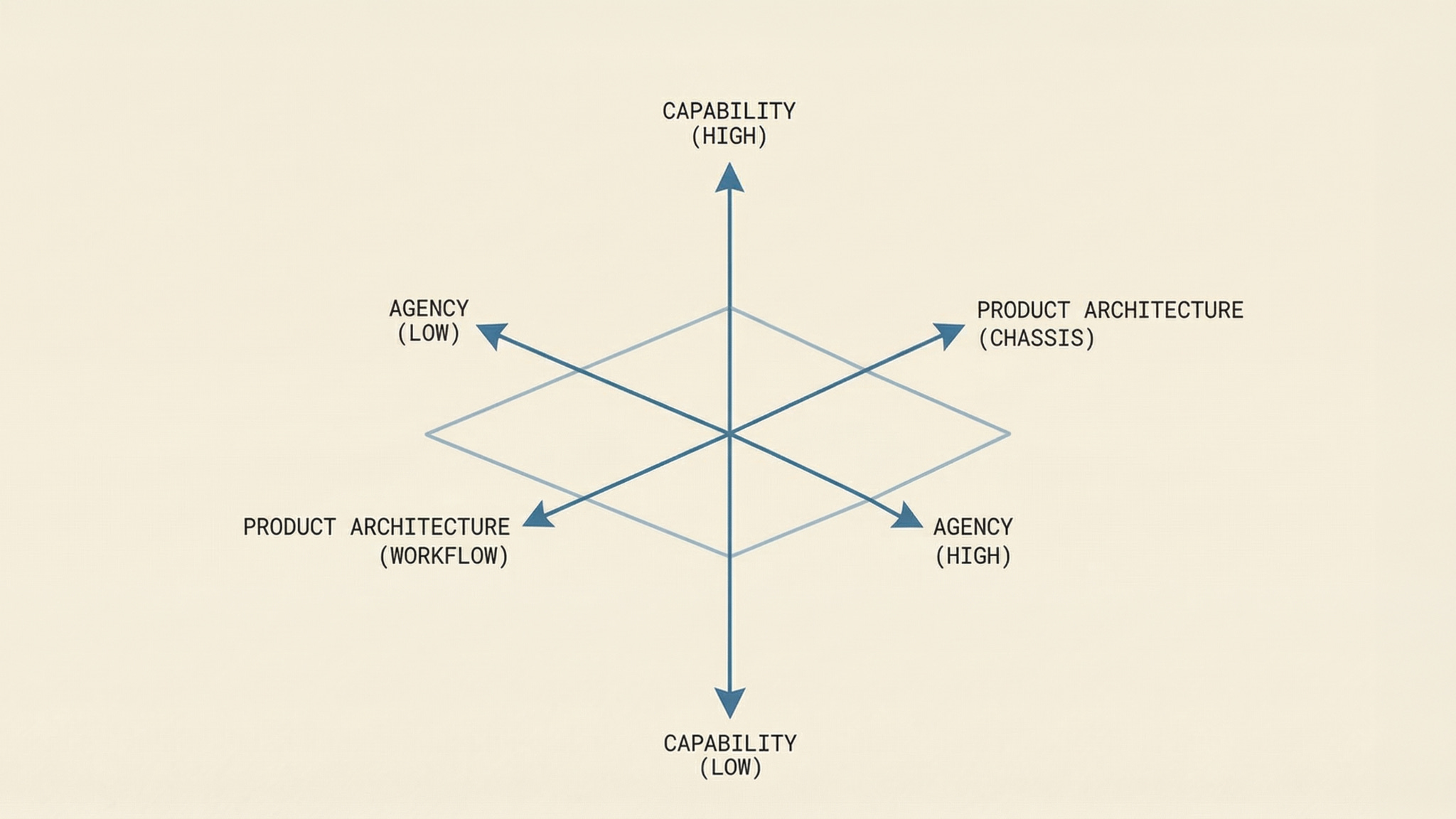
Companies At Risk
Run those dimensions together and a few patterns emerge. This may be sobering, especially if it describes your starting point.
Software for software companies. For founders building horizontal workflow applications for high-agency, high-capability organizations, this is aimed at you. If your customer’s team looks a lot like yours (talented engineers with access to frontier models), you’re in danger. They’ll just build it themselves.
Startups and mid-market tech companies are the most dangerous ICP in 2026. We’ve heard this firsthand from internal teams at startups and mid-market tech companies building their own versions of workflow tools they used to pay for — what would have taken months to procure and implement a year ago is now a weekend project. And it’s not just them. Engineers at multiple frontier labs are doing the same thing.
One conclusion here is that low capability + low agency customers who used to seem “boring” (enterprise-focused, services-heavy, slow procurement) are now relatively attractive. The slog is the moat.
Building around model deficiencies. Look at video and image apps. A year ago, it might have been sufficient to say “it doesn’t do inpainting well” or “character consistency in video is broken.” That kind of thinking is now a losing bet.
Model capabilities are non-linear. The behavior is so emergent that what’s hard today becomes trivial tomorrow.
You should assume that the models will eventually do everything.
Build something that gets stronger as the models improve. Not something they make obsolete with the next release.
How To Survive
Survival hinges on how you respond. It’s no longer whether you can build—it’s whether you know what to build, and why, before the window closes.
Strategy can’t wait. Everyone can build fast now. I met two non-technical founders in New York who built fully-fledged products in two days. That’s incredible, but it also means build speed is table stakes.
The old playbook was to build something cool, raise money, figure out the hard stuff later. You had a few years of runway to figure out your strategy. That’s over. The premium is now strategic speed. Technical founders have to lean into the discomfort of answering questions that used to wait until Year 2. The questions about who you’re really building for and where the puck is going now need answers in months, sometimes weeks. You have to be intentional from Day -1.
Go deep on domain. AI is the ingredient. Domain mastery is the product. Find a space where you understand the customer, the workflow, and the problem better than any lab ever will. Legal, healthcare, energy, agriculture, construction — these are industries delivering services and goods, not building software. They’re low technical capability, low agency, and the enterprise go-to-market is hard enough that the labs won’t bother.
One useful reframe: imagine every lawyer, financial analyst, contractor and nurse as a software engineer with domain knowledge. What would you build that these hybrids would need?
Seek out human problems. Selling. Change management. Trust. Compliance. Network effects. Community. The edge is who can get closest to the customer, navigate procurement, and do the messy work of actually getting customers to discover, buy and adopt technology.
Any place where the problem is fundamentally about people, that’s where to focus.
Build chassis products. Chassis is how you end up on Sauron’s side, not under its threat. There are deeply technical problems (AI research loops, bare-metal deployment at scale, compliance and audit infrastructure, SCIM management) where coding agents don’t meaningfully outperform experts over the next 24 months. At the same time, enterprises want these new capabilities but aren’t built to absorb them. If you can build the systems that let companies safely accept and leverage AI capabilities at scale, that’s a powerful position.
Atoms over bits. AI meets robotics, drones, hard tech, science, and biology — and the rules change. A coding agent can’t weld a joint, fly a survey mission, synthesize a compound, or validate a clinical finding.
The moats here are real: proprietary hardware, physical distribution, regulatory approval, and years of operational data that can’t be scraped. These are categories where the foundation model companies aren’t coming for you…yet.
This isn’t meant to be all doom and gloom. In many ways, this is the most exciting time to build in decades.
Yes, Sauron’s line of sight is larger. But the opportunities have never been greater. Customers are eager to try and buy new tools. Companies are clearing seven figures in revenue per employee. What once required large teams and months of work can now be built by a handful of people in days.
The founders who win won’t just build faster.
They’ll pick problems the Eye can’t see.
Interested in SPC? Apply to join us here.

Thank you for writing this and sharing, Evan!